
The microwave cordon bleu is the compromise for a busy everyday life: quick, no dishes, ready in just a few minutes. The problem is that most manufacturers of frozen cordon bleus themselves advise against this cooking method.
Gimbert Océan clearly states on its salmon fillet cordon bleus not to use the microwave. The reason lies in two factors: a coating that softens instead of browning, and sometimes uneven cooking at the core of thick products.
Why the coating of the cordon bleu softens in the microwave
Microwaves heat by agitating the water molecules contained in the food. The breadcrumbs, meant to form a dry and crispy crust, come into direct contact with the steam released by the melted cheese and ham. Instead of grilling, it absorbs this moisture. The result: a soft, rubbery coating with no structure.
Baking in the oven or frying works on an opposite principle. Dry heat (oven) or hot fat (pan) dehydrates the surface of the coating and triggers the Maillard reaction, that golden coloring that gives crispness. The microwave cannot reproduce the Maillard reaction, regardless of the power or duration chosen.
Read also : Tips and Tricks for Successfully Renting Your Property with Peace of Mind
The microwave cooking of the cordon bleu is still practiced, especially to reheat a pre-cooked cordon bleu. In this specific case, the product already has its crust formed, and we are simply looking to bring it back to temperature, not to cook it from scratch.
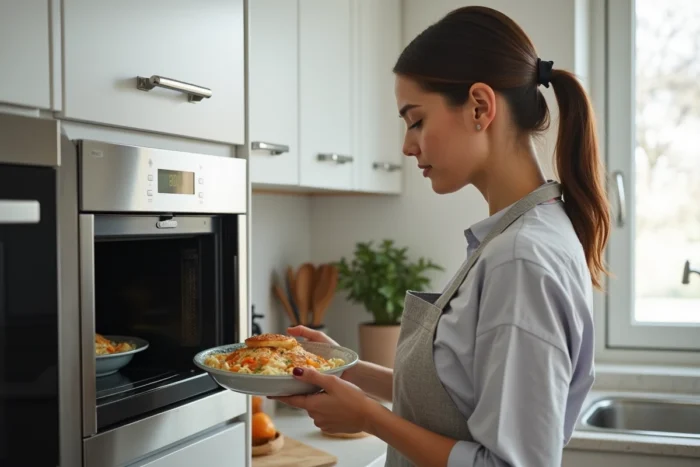
Frozen cordon bleu in the microwave: method and limits
If you start with a raw frozen cordon bleu, the microwave alone will not yield a satisfactory result in terms of texture. The coating will be soft, the cheese will likely have leaked out the sides, and the cooking at the core remains uncertain on a thick product.
For those who have no other option, here is a two-step approach that limits the damage:
- Take the cordon bleu out of the freezer and let it partially thaw in the refrigerator for about twenty minutes, or use the microwave’s defrost function at reduced power. A product that is still partially frozen in the center will cook unevenly.
- Place the cordon bleu on a plate covered with paper towels. The paper absorbs some of the released moisture and limits (a bit) the softening of the breadcrumbs.
- Heat at medium power rather than full power, turning the cordon bleu halfway through cooking. Maximum power creates hot spots that dry out some areas while others remain lukewarm.
Turning the cordon bleu halfway through cooking is the only way to achieve a slightly more even heat. Microwaves without a rotating plate exacerbate the problem of cold spots.
The issue of core temperature
For chicken or turkey, reaching 74 °C at the core is the recommendation to ensure proper microbiological safety. Homemade cordon bleu recipes (air fryer, pan then oven) now incorporate this guideline. In the microwave, without a kitchen thermometer, it’s a gamble. The melted cheese in the center may give the illusion that the product is cooked, while the escalope itself has not reached the right temperature throughout.
A probe thermometer remains the only reliable way to check. If you don’t have one, cut the cordon bleu in half after cooking: the meat should show no pink areas.
Microwave accessories: does the crisp change the game?
Some recent microwaves include a crisp or grill function, sometimes with a dedicated plate (like Tupperware’s Micro Pro Grill). The principle: a plate that heats from below using microwaves and creates a hot surface contact, simulating a frying pan effect.
Field reports vary on this point. With a Micro Pro Grill, the common method is to cook the cordon bleu for about five minutes at high power, then turn it over and restart for five minutes, with the lid in a low position. The combination of microwave and crisp plate produces a firmer crust than a standard microwave, but the result still falls short of an oven or air fryer.
The real advantage of these accessories is speed. While an oven requires a preheating time of ten to fifteen minutes before even putting it in, the crisp plate delivers an edible result in less than ten minutes total.
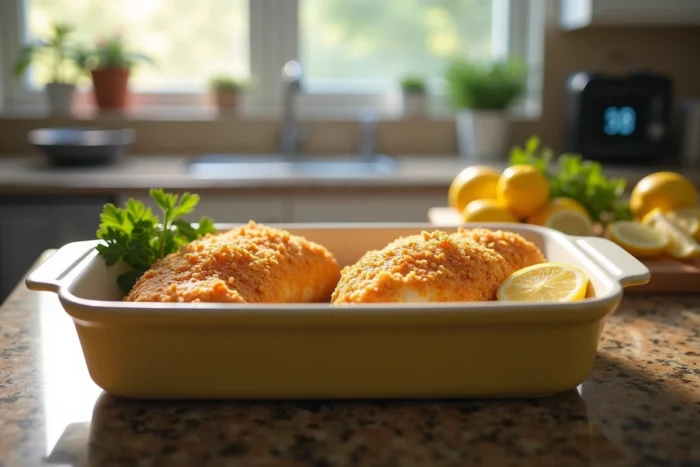
Homemade or industrial cordon bleu: the microwave does not forgive the same mistakes
A homemade cordon bleu, prepared with fresh escalopes, a slice of ham, and cheese like emmental or beaufort, behaves differently from an industrial frozen product in the microwave.
The homemade product is generally thinner, which facilitates even cooking. The homemade coating (classic breadcrumbs or panko) absorbs fewer stabilizing additives than the industrial coating, but it also softens more quickly. On the other hand, a fresh homemade cordon bleu cooked in the microwave more easily reaches a uniform temperature than a thick frozen one.
The industrial cordon bleu often contains a thicker layer of coating and a denser filling. It is designed for oven or pan cooking. In the microwave, thickness works against it: the outside overheats while the core remains cold.
The air fryer as a quick alternative
For those looking for speed without sacrificing crispness, the air fryer has emerged as a direct competitor to the microwave. Cooking with hot air mimics an oven effect in a shorter time, and the coating browns properly. The air fryer remains the best compromise between speed and crispy texture for a frozen cordon bleu today.
Reheating a pre-cooked cordon bleu in the microwave
This is the only scenario where the microwave works without too many compromises. A pre-cooked cordon bleu (leftovers from the day before, prepared in the oven or pan) already has its crust formed and its core cooking assured.
To reheat it, a few tens of seconds at medium power are sufficient. Beyond that, the cheese escapes, the coating becomes mushy, and the escalope dries out. The paper towel under the cordon bleu remains useful to absorb excess moisture.
The microwave for reheating a pre-cooked cordon bleu fulfills its role. To cook a raw frozen cordon bleu without any crisp accessory, the available data do not allow for a satisfactory result, either in texture or food safety on thick products. The oven, pan, or air fryer remain the preferred methods when possible.