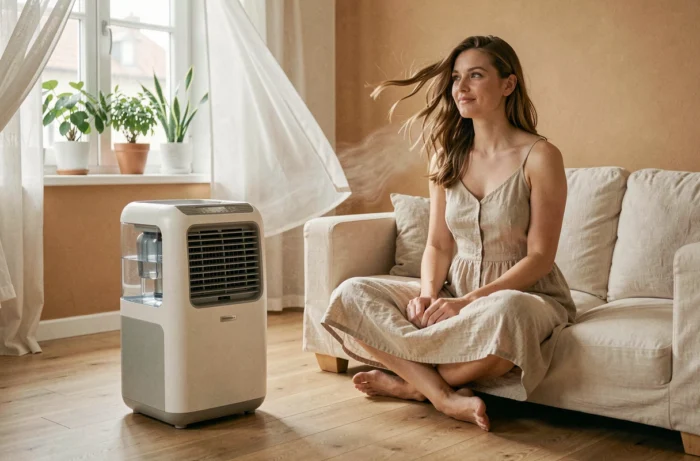
An air cooler operates without refrigerant gas, without a drainage hose, and without any installation work. It uses a simple physical principle: the evaporation of water absorbs heat from the surrounding air. Before purchasing one, understanding this mechanism allows you to anticipate its true results and avoid disappointments during a heatwave.
Adiabatic evaporation: the physical principle behind the cooler
You may have noticed the feeling of coolness when stepping out of a pool on a hot day? The water on your skin evaporates, and this transformation consumes energy in the form of heat. Your body cools down. The air cooler replicates this phenomenon, known as adiabatic evaporation cooling.
The device contains a water reservoir, sometimes several liters. A pump circulates this water over a cellulose pad, also known as a wet media or evaporative filter. A fan draws in the warm air from the room and forces it through this wet pad.
In contact with the wet filter, some of the water changes from a liquid state to a gaseous state. This transformation absorbs calories present in the air. The air that comes out of the device is therefore cooler, but also more humid.
To fully understand how an air cooler works, one point must be remembered: the device does not expel heat outside. Unlike an air conditioner, there is no outdoor unit. The air is cooled in the room, and the heat is “consumed” by the change of state of the water.
Temperature and humidity: why the cooler doesn’t work the same everywhere
The efficiency of an air cooler directly depends on the ambient humidity. The drier the air, the more it can absorb water vapor, and the more pronounced the cooling effect. In a dry Mediterranean climate, the temperature drop will be noticeable. In Brittany on a humid afternoon, the result will be almost negligible.
This is the main trap of this device. When the air is already saturated with humidity, evaporation no longer occurs. The fan runs, the water circulates, but the room does not cool down. It simply becomes more humid.
Monitor two parameters, not just one
Most users only look at the thermometer. Also tracking the indoor humidity level provides much more reliable information about the actual efficiency of the device. A hygrometer costing a few euros is sufficient.
If the relative humidity exceeds a certain threshold in the room, the air cooler adds water vapor without thermal benefit. The device either cools or makes the room more humid: this is the question to ask during use.
A simple rule: regularly ventilate the room while in use. Leaving a window slightly open allows the humidified air to escape and lets outside air (potentially drier) replace it. Without this cross-ventilation, humidity accumulates and cooling stops.
Maintenance of the reservoir and indoor air quality
The stagnant water reservoir and the wet filter create a favorable environment for the growth of microorganisms. A poorly cleaned device can disperse mold spores with the airflow, as noted by Bosch in its recommendations for these devices.
This health risk is rarely highlighted at the time of purchase. However, it turns a device meant to enhance comfort into a potential source of respiratory problems, especially for sensitive or allergic individuals.
Maintenance actions not to be neglected
- Empty and rinse the water reservoir after each day of prolonged use, even if water remains
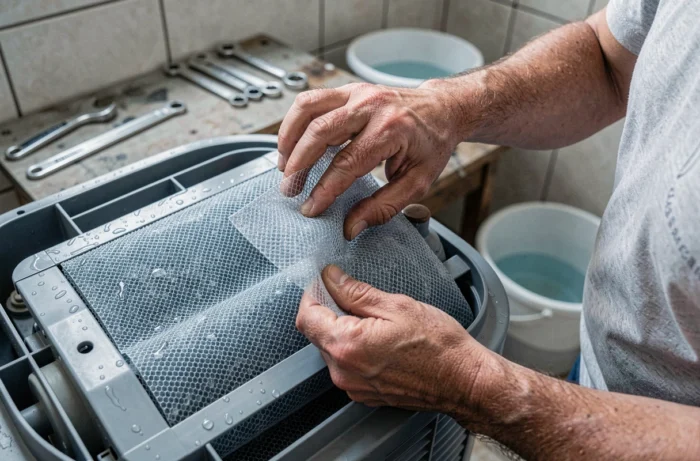
- Clean or replace the cellulose pad according to the manufacturer’s instructions, as a clogged filter reduces airflow and promotes bacteria
- Leave the device open to dry when not in use for several days to avoid stagnant residual water
These actions take just a few minutes. They condition both the quality of the air blown and the lifespan of the device.

Air cooler at night: comfort that has its limits
Many people consider the cooler for sleeping cool. The nighttime operation poses two specific constraints.
The first is noise. The integrated fan produces a noise level that can exceed comfort thresholds for a bedroom. If you are sensitive to noise, test the device in night mode (when available) before placing it at the foot of the bed.
The second is the reservoir’s autonomy. The cooler continuously consumes water. Depending on the reservoir’s capacity and the chosen fan speed, the water may run out in the middle of the night. The device then continues to ventilate without cooling, which is equivalent to a simple fan.
Air conditioner or cooler: not the same promise
The portable or fixed air conditioner extracts heat from the room and expels it outside via a hose or outdoor unit. It precisely controls the temperature. The air cooler, on the other hand, offers a drop of only a few degrees, varying according to humidity levels.
- The air conditioner operates in a closed circuit (windows closed), while the cooler requires room ventilation
- The air conditioner consumes significantly more energy and uses a refrigerant with environmental impact
- The cooler does not allow setting a target temperature; its effect depends on ambient conditions
Presenting the cooler as air conditioning without a hose creates an expectation that the device cannot meet. The cooler is a compromise between a fan and an air conditioner, not a substitute for the latter.
For a cool summer in a well-ventilated room and a not too humid climate, the air cooler remains an economical and easy-to-install solution. Where it reaches its limits is in regions where humidity rises alongside heat. Measuring the humidity of your home before purchase avoids the unpleasant surprise of mid-July.