A raised vegetable bed is not filled like a flower pot. The structure, whether made of wood, metal, or recycled plastic, imposes constraints on weight, drainage, and substrate durability that directly affect the quality of the harvest. The choice of filling materials, their stacking order, and their evolution over the seasons form the technical foundation upon which the productivity of the bed rests.
Weight constraints on balconies and terraces: adapting the filling to the support
Most guides on raised vegetable beds assume that the bed rests on solid ground. In an urban context, on a balcony or terrace, the situation changes radically. A conventional substrate (garden soil, gravel, compost) can weigh several hundred kilos when wet, which exceeds the load capacity of many structures.
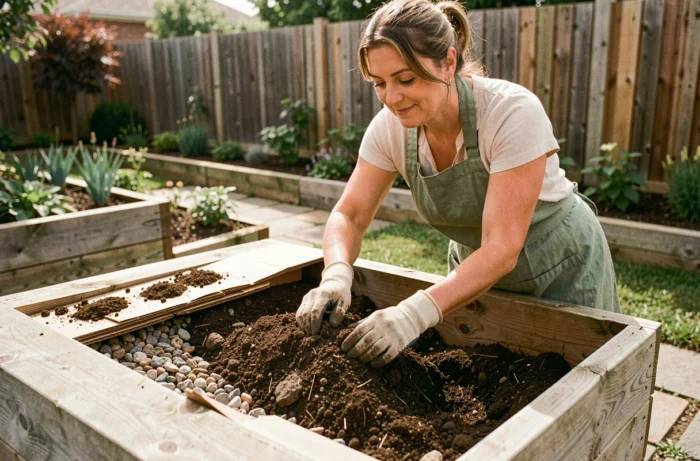
The solution lies in using lightweight draining materials at the bottom of the bed: expanded clay balls, pumice, crushed cork, or even recycled polystyrene. These alternatives replace gravel and stones without sacrificing drainage. Above, a mix of peat-free potting soil, mature compost, and perlite or vermiculite further reduces the total weight while maintaining good porosity.
For those who wish to discover La P’tite Graine’s tips on effective filling, this lightweight approach serves as a good starting point before choosing layers.
This weight calculation is not trivial. A permaculture bed filled carelessly on a balcony can pose a structural problem. Checking the load capacity before filling any bed remains the first step, well before choosing the seeds.
Lasagna filling: layers and materials for fertile soil
The so-called “lasagna” method involves stacking layers of brown organic materials (rich in carbon) and green materials (rich in nitrogen) to create a living substrate that decomposes gradually. This system nourishes plants over several seasons without massive fertilizer input.
Order of layers in a raised vegetable bed
From the bottom to the surface, the logic follows a decomposition gradient:
- At the bottom of the bed, branches, small logs, or fragmented dead wood. This woody material decomposes slowly and creates air pockets that promote drainage while storing water through capillarity.
- Above, a layer of brown materials: dead leaves, raw cardboard (without ink or plastic coating), straw. These carbon-rich materials feed the soil fungi and structure the substrate.
- Next, a layer of green materials: fresh grass clippings, kitchen scraps, coffee grounds. The nitrogen they release accelerates the decomposition of the lower layers.
- On the surface, a mix of mature compost and quality potting soil, with a thickness sufficient to accommodate the roots of vegetable plants.
The alternation of brown and green layers mimics the functioning of a forest soil. The wood at the bottom of the bed acts like a sponge: it absorbs excess water and releases it during dry periods, reducing the frequency of watering.
Should a geotextile be placed at the bottom of the bed?
Field reports vary on this point. A geotextile prevents soil from leaking out the bottom and slows down weeds if the bed is placed on the ground. However, it may limit contact with soil fauna (earthworms, microorganisms) and reduce drainage if the weight is too high.
For a raised bed on legs with a closed bottom, a fine geotextile is sufficient to retain the substrate without blocking water. For an open bed placed on the ground, favoring a permeable fabric over a plastic tarp preserves biological exchanges between the natural soil and the bed’s substrate.
Protecting the walls and longevity of metal or wooden vegetable beds
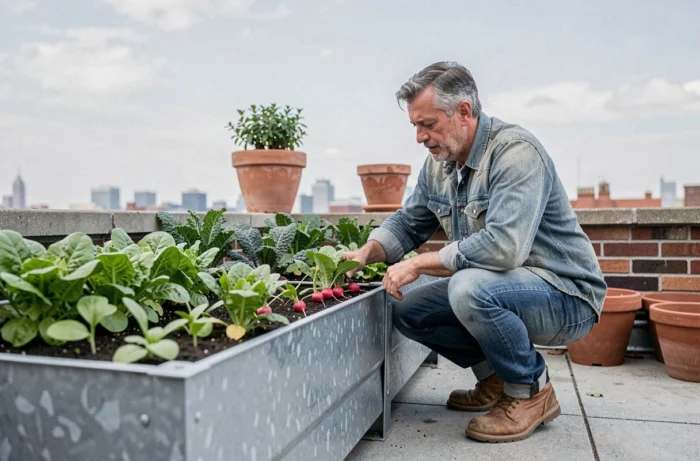
The material of the bed itself influences the filling strategy. A bed made of steel sheet or aluminum can heat up significantly in the sun, which dries out the substrate at the edges and stresses the roots. To limit this overheating, insulating the inner walls with cork, thick cardboard, or a geotextile creates an effective thermal barrier.
High-strength steel or galvanized sheet beds offer longevity of twenty to thirty years outdoors, justifying an investment in a lasting lasagna-type filling. Untreated wood, depending on the species chosen, lasts less long and requires more frequent replacement of the container.
This difference in durability changes the perspective. With a durable metal bed, it becomes cost-effective to build a sophisticated layering system that is enriched year after year, without having to empty everything to replace the structure.
Renewing and enriching the substrate of a raised vegetable bed season after season
A raised bed loses volume each year. The decomposition of organic materials lowers the substrate level, sometimes significantly after the first season. This settling is normal and even desirable: it means that the soil is alive.
The action to take at the beginning of each season is to top up the bed. Adding mature compost and organic mulch compensates for settling and revitalizes biological activity. Avoiding deep turning of the layers preserves the stratification and mycorrhizal networks that have established.
Surface mulching (straw, hay, wood chips) serves a triple role: it limits water evaporation, regulates soil temperature, and nourishes the upper layer as it decomposes. This mulch is renewed two to three times a year depending on the climate and the type of crop.
A well-filled raised vegetable bed is not a static system. It is a miniature ecosystem that gains fertility over time, provided the balance between carbon materials, nitrogen inputs, and soil biological life is respected. The initial filling sets the trajectory, but it is the regular maintenance of the substrate that determines the quality of the harvests over time.