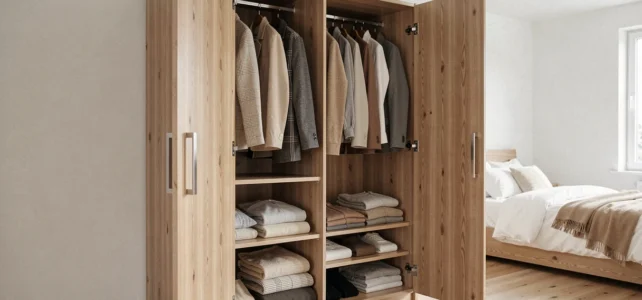
A storage cabinet is defined by three technical parameters: its useful volume in liters, its footprint, and the internal configuration of its compartments. These three data points determine whether the furniture will solve a space problem or exacerbate it. Before comparing styles or finishes, the priority remains to quantify what the cabinet needs to hold and the physical space it has available.
Formaldehyde emissions and air quality: an invisible criterion that carries weight
Cabinets made of particle board, MDF, or plywood emit volatile organic compounds (VOCs), primarily formaldehyde from the adhesives used during manufacturing. In a small or poorly ventilated room, these emissions can significantly degrade indoor air quality.
Recommended read : Discover the best alternatives to replace Tirexo and access your favorite content
In France, the VOC label classifies furniture from A+ to C based on their emissions measured in a standardized test chamber. Class A+ corresponds, for formaldehyde, to emissions below 10 µg/m³, well below current regulatory thresholds. When comparing two similar cabinets in price and dimensions, this label makes a difference, especially for a child’s room or a space with limited ventilation.
The European REACH regulation also imposes stricter new ceilings for formaldehyde in wood-based panels. Cabinets placed on the market after August 2026 will, on average, be less emissive than older models. Entry-level manufacturers, who used heavily loaded resins, must revise their processes. For a sustainable purchase, opting for a AC3M cabinet on J3M allows you to consult references compliant with the latest standards.
Recommended read : How to Choose the Right Garden Shredder for Successful Mulching in Your Garden

Internal configuration of the cabinet: hanging space, shelves, and drawers
The gross volume of a cabinet says nothing about its efficiency. A large-capacity piece of furniture that is poorly compartmentalized wastes space, while a more compact cabinet with suitable internal organization stores more. It all depends on the distribution between three functional areas.
Hanging space and hanging rod
Long garments (coats, dresses, suits) require a hanging height of at least 130 cm. Jackets and shirts can manage with about 100 cm. If your wardrobe mainly contains short pieces, a double hanging rod doubles the hanging capacity within the same width.
Fixed or removable shelves
Removable shelves offer real flexibility: you adjust the height according to the stacks of sweaters, sheets, or boxes. Fixed shelves, on the other hand, better support heavy loads. A good compromise is to mix both in the same piece of furniture.
Integrated drawers or added accessories
Drawers integrated into the cabinet are suitable for small items (underwear, accessories, belts). Baskets or bins added serve the same function at a lower cost, but slide less smoothly and wear out faster. Here are the elements to check before finalizing your configuration:
- The proportion of clothes to hang compared to folded clothes, which determines the hanging/shelf ratio
- The presence of a dedicated shoe space, often underestimated and responsible for clutter at the bottom of the cabinet
- The number of drawers needed for small items that you do not want to stack on an open shelf
Hinged doors or sliding doors: impact on circulation
The type of opening directly modifies the footprint of the cabinet in the room. This choice is not about style, but about the geometry of your space.
Hinged doors require a frontal clearance equivalent to the width of one door leaf. In a narrow hallway or facing a bed placed near the wall, they become a daily obstacle. Their advantage: they provide complete visual access to the inside of the furniture with a single opening.
Sliding doors eliminate this clearance. They are suitable for rooms where every centimeter counts. The downside, rarely mentioned, is that you only see half of the cabinet at a time. Storing or searching for a garment takes longer, and the floor guide rails accumulate dust.
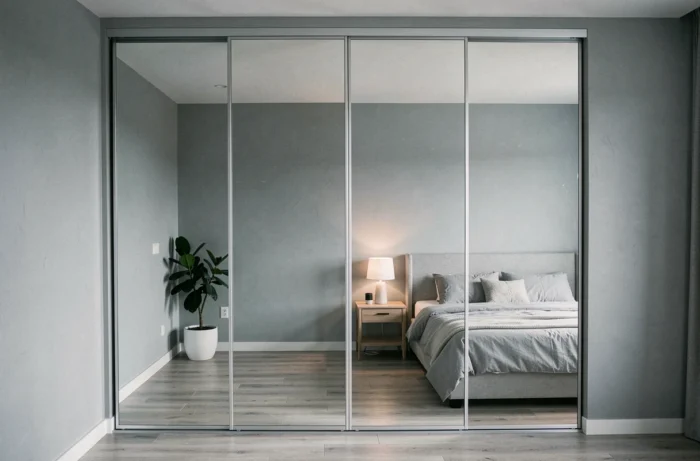
For very small spaces, some cabinets offer folding doors (accordion style). They combine a reduced clearance with wider access than sliding doors, but their mechanism is less robust over the long term.
Cabinet materials and durability: solid wood, MDF, or melamine
The material determines the longevity, weight, and price of the furniture. Three major families dominate the market:
- Solid wood (oak, pine, beech) supports heavy loads and ages well, but is heavy and significantly more expensive than reconstituted panels
- MDF (medium-density fiberboard) offers smooth surfaces, easy to lacquer or veneer, with reasonable resistance to moderate loads
- Melamine (particle board covered with a thermally bonded decor) represents the entry-level, with a storage volume/price ratio hard to beat, but is sensitive to moisture and impacts on the edges
On melamine, always check the edges: a hot-glued ABS edge resists much better than a simply veneered edge. This is often the first area of degradation on an entry-level cabinet.
The weight of the furniture also influences its placement. A large solid oak cabinet can exceed 100 kg. In an old apartment with wooden flooring, the load on the floor deserves to be evaluated, especially if the cabinet is positioned against a non-load-bearing wall.
The choice of a cabinet ultimately relies on a trade-off between three constraints that do not compensate for each other: the available space in the room, the nature of what you store, and the air quality you breathe, a parameter that the new European regulation on formaldehyde will make easier to objectify starting in 2026.