
The party game market has significantly expanded in recent years, well beyond the classic board games that are habitually brought out. Between physical party games, no-material formats, and mobile apps used directly on a phone placed in the center of the table, the options for livening up an evening have multiplied. This diversity raises a concrete question: what criteria should be used to choose a game suitable for your group?
No-material party games: a trend redefining group entertainment
Since 2024, several specialized guides have noted the rise of games that require neither a box nor setup. The improvised blind test with a smartphone, quizzes created on the spot, simplified role-playing games, or physical challenges meet a need for spontaneity that classic board games do not always cover.
See also : How to Choose the Best Wardrobe to Optimize Your Interior Space
This shift has a fairly straightforward explanation. When hosting at the last minute or when the group consists of very different profiles (children, teenagers, adults), a no-material game starts in under a minute and requires no reading of rules. The salad bowl game, for example, works with pieces of paper and a bowl. Each player writes names of personalities, and then the teams must get them guessed in three successive rounds with increasing constraints.
Feedback from the field varies on this point: some groups find these formats too dependent on the energy of the host, whereas a boxed game structures the game on its own. The choice largely depends on the group’s dynamics and the number of players present.
Read also : Discover the best alternatives to replace Tirexo and access your favorite content
To explore a catalog that ranges from party games to more strategic formats, one can browse the references available on lechaudrondesjeux.com and compare the mechanics before investing in a box.

Apps and digital platforms for group evenings
The other recent phenomenon concerns the integration of free digital party games into gatherings and meetings among friends. Platforms like Zikof offer blind tests and quizzes accessible via smartphone or TV, without prior registration or download. Dedicated mobile apps (Truth or Dare, “Never Have I Ever”, “Would You Rather”) allow you to start a game in seconds.
These digital tools do not replace physical games, but they fill a specific gap: the moment when no one has brought a game and the conversation starts to stall. Their main limitation remains the dependence on a screen, which can fragment the group’s attention instead of uniting it.
What these formats change in the choice of a game
The existence of these free alternatives alters expectations for boxed games. A purchased board game must now justify its price with something an app cannot offer: enjoyable materials to handle, mechanics that create tension around the table, or replayability that digital formats struggle to match.
A physical card game generates interactions that the screen cannot replicate: eye contact during a bluff, the gesture of placing a card, the collective reaction when a move turns the game around. It is in this area that boxed party games maintain their advantage.
Concrete criteria for choosing a game suitable for your group
Most recommendation lists align titles without explaining why a particular game fits a specific context. The criteria that make a difference in practice are, however, identifiable.
- The actual number of players, not theoretical. A game advertised as “for 2 to 8 players” rarely works as well with 2 as it does with 8. Bluff and deduction games (like hidden roles) take on their dimension starting from 5 or 6 participants. Fast card games hold up better with 3 or 4.
- The time to explain the rules. Beyond five minutes of explanation, part of the group loses interest. Games whose mechanics can be understood by playing the first round (placing a card, choosing a word, miming a concept) keep everyone engaged.
- Tolerance for elimination. A game that eliminates players during play creates frustrated spectators. For a family evening with children, formats where everyone plays until the end avoid tensions.
- The duration of a game. Short formats (around twenty minutes) allow for immediate relaunching, while longer games are better suited for a small, motivated group.
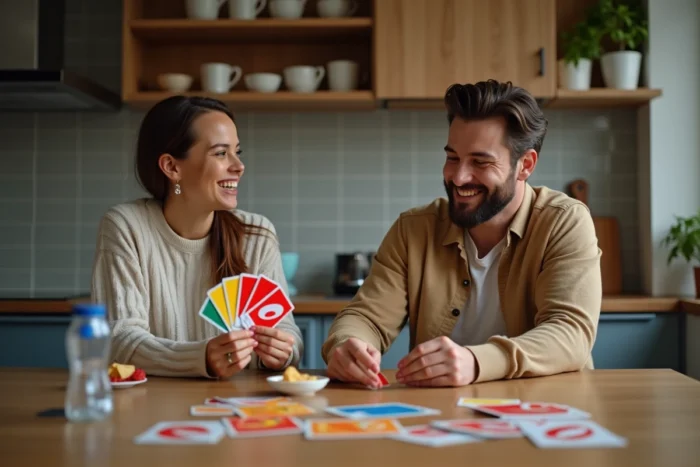
Bluff, speed, cooperation: three mechanics, three atmospheres
Bluff games (hidden roles, assumed lying) create a social tension that appeals to close-knit groups but can make players who know each other little uncomfortable. Speed games (visual recognition, reflexes) work conversely as effective icebreakers, as they require no prior knowledge between participants.
Cooperative games, where the entire team wins or loses together, represent a third often underestimated avenue for family evenings. They eliminate direct competition and allow players of very different levels to contribute without frustration. This mechanic is particularly suitable for intergenerational groups bringing children and adults together around the same table.
Board games with family and children: adapting the format to the actual age
The age indications on game boxes are legal minimums, not playful recommendations. A game marked “8+” can perfectly bore a 9-year-old if the mechanics rely on cultural references they do not yet possess.
For family evenings with children under 10, games based on observation or physical action work better than those requiring quick reading or mental calculation. Mime games, stacking games, or shape recognition keep attention for short durations and allow adults to play without condescension.
With teenagers, general knowledge or guessing games take on a different turn. Thematic quizzes, whether boxed or improvised via an app, create a competitive dynamic that this age group particularly enjoys. The mixed team format (one adult and one teenager together) balances knowledge levels and generates unexpected alliances.
Ultimately, the choice of a party game relies less on the title than on the composition of the group and the moment of the evening. The same group can go from a speed game during the appetizer, to a cooperative format during the meal, and then to a bluff game at the end of the evening, each mechanic responding to a different energy. The only real mistake would be to force a single format on a group that does not want it.