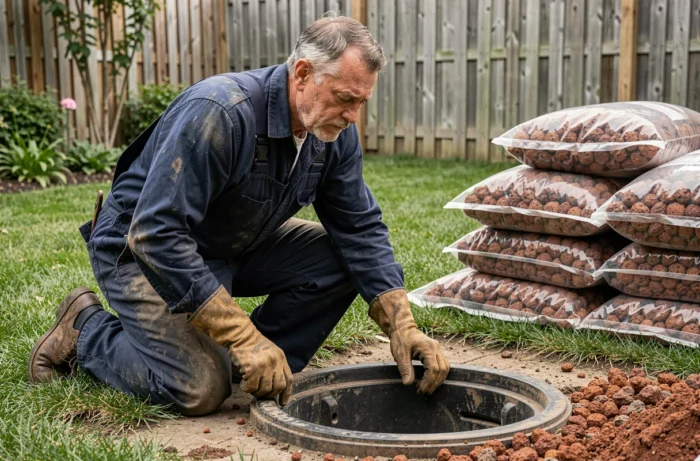
Pumice occupies the pre-filter compartment of most all-water tanks installed in non-collective sanitation systems. This porous volcanic rock retains solid materials before they reach the downstream treatment device. Its role seems simple, but the real constraints related to its use, lifespan, and maintenance often remain unclear in the documentation available to individuals.
Pumice in pre-filter: how porosity changes biological functioning
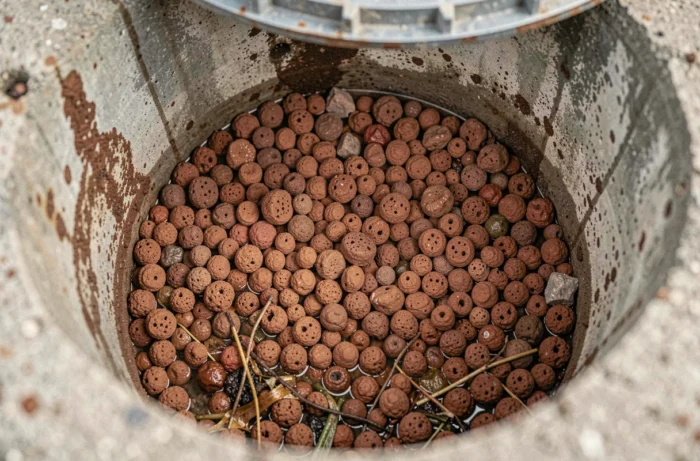
The alveolar structure of pumice is not limited to a mechanical sieve effect. Its cavities provide a colonization surface for anaerobic bacteria that participate in the degradation of suspended organic matter. The pre-filter thus becomes a first stage of biological treatment, not just a physical barrier.
This dual function explains why a replacement with a plastic grid pre-filter does not produce exactly the same result. Plastic retains particles, but pumice hosts complementary bacterial activity that reduces the organic load transmitted to the sand filter or the drainage system.
The distinction has a direct practical consequence: when choosing to use pumice in a septic tank, one opts for a living filtering medium, which requires minimal conditions to function (constant humidity, absence of excessive biocidal products).
All-water tank and fats: why pumice pre-filters are more stressed than one might think
Current installations are no longer just simple septic tanks receiving only the wastewater from toilets. Regulations now require all-water tanks, which also collect grey water from kitchens, showers, and washing machines. This point radically changes the load that the pre-filter endures.
Food fats, soap residues, and surfactants from detergents clog pumice much faster than just fecal matter. The bacterial biofilm, useful under normal conditions, can be destroyed by an excess of household chemicals. The result: the rock loses its biological function while becoming mechanically clogged.
Field reports vary on the speed of this clogging, as it depends on the volume of greasy water, the size of the basket, and the household habits. A household that uses a lot of frying and aggressive detergents will stress the pre-filter very differently than a household with more modest practices.
Lifespan and signs for replacing pumice in a septic tank
Most articles simply recommend “regular cleaning” without providing concrete benchmarks. A specialized guide on pumice baskets in concrete tanks indicates a recommended lifespan of 7 to 9 years before replacement, with a condition check at least every two years to adjust this timeframe.
Three concrete signals indicate that the pumice is nearing the end of its life:
- Persistent odors at the pre-filter level, even after a water jet cleaning, signal a deep clogging of the rock’s pores.
- A visible slowdown of drainage in the tank’s outlet compartment indicates an obstruction that can no longer be resolved by simple rinsing.
- A visually clogged appearance of the basket, where the rock seems agglomerated and no longer allows water to pass through, confirms that replacement is becoming necessary.
Cleaning pumice with a high-pressure water jet extends its lifespan by a few years, but does not indefinitely restore its original porosity. Complete replacement remains inevitable in the long run, and it is better to plan for it than to face it during a malfunction.
SPANC control and compliance of the pre-filter in non-collective sanitation
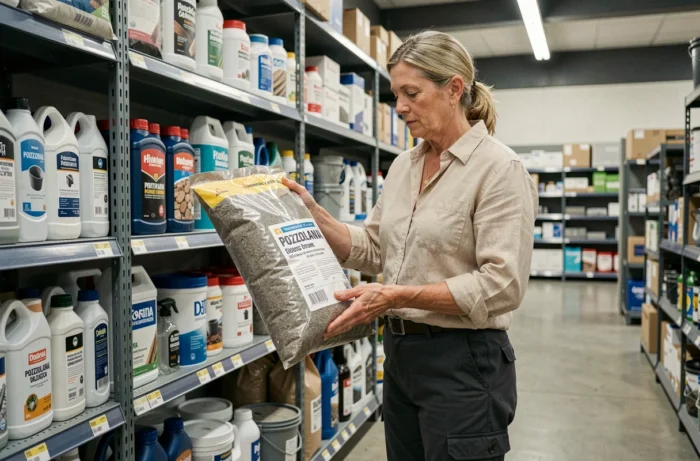
The Public Service of Non-Collective Sanitation (SPANC) conducts periodic checks on individual installations. During these visits, the condition of the pre-filter is one of the points checked. Clogged or absent pumice can lead to an unfavorable opinion, with an obligation to comply within a timeframe set by the community.
Requirements vary from one SPANC to another. Some accept plastic pre-filters as an alternative, while others consider that pumice remains the reference filtering medium for traditional concrete tanks. This local heterogeneity complicates the task for owners seeking a single answer.
In practice, the most frequently noted point of vigilance during inspections concerns the pumice basket that has not been cleaned or replaced since the initial installation. Many owners are unaware that this compartment exists or that it requires maintenance separate from the tank’s emptying.
Concrete precautions to preserve pumice in an all-water tank
The first reflex is to limit the arrival of fats into the tank. An upstream grease trap, connected to kitchen water, significantly reduces the lipid load that reaches the pre-filter. This installation is not systematic in older homes, but it extends the useful lifespan of the volcanic rock.
The choice of household products also plays a direct role. Chlorine-based detergents or chemical drain cleaners destroy the bacterial colonies fixed in the pores of the pumice. Products labeled compatible with autonomous sanitation preserve this biological activity.
- Check the pumice basket at least every two years, regardless of the tank emptying.
- Rinse the rock with a water jet during each check to dislodge superficial deposits before they penetrate deeply.
- Plan for the complete replacement of the filtering medium within the recommended timeframe, without waiting for advanced clogging symptoms.
- Never throw wipes, cotton swabs, or sanitary products into the toilet: these wastes block the basket even before the pumice becomes naturally soiled.
Pumice remains a sober, inexpensive, and effective material for pre-filtration in non-collective sanitation. Its main limitation lies in forgetfulness: installed once, it disappears from the maintenance radar of owners until the day drainage slows down or SPANC signals a problem. Regular visual checks and planned replacement are sufficient to keep the system in good condition over the long term.