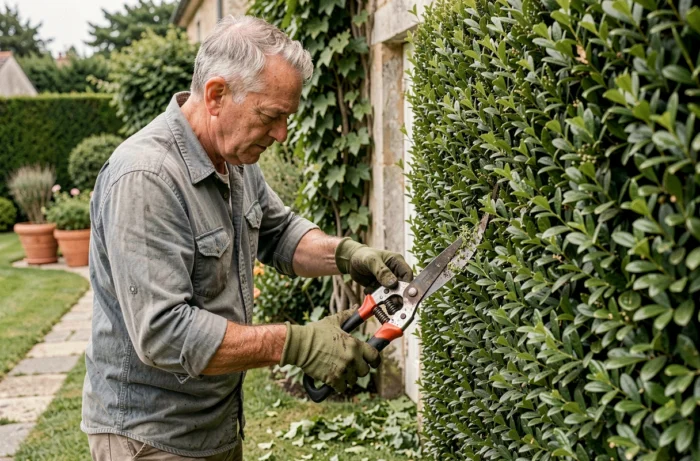
The success of hedge trimming relies less on the power of the tool than on understanding the plant. Grasping the branching physiology of a shrub, its budding method, and its response to cutting determines the entire outcome. A poorly managed hedge cannot be corrected in a single season.
Physiological response of shrubs to cutting: trimming at the right level
Each species reacts differently to the removal of wood. Evergreens like laurel or privet activate their latent buds close to the cut, allowing for rapid densification of the outer foliage. Deciduous plants, on the other hand, redistribute sap to dormant buds located lower on the branch. Ignoring this distinction leads to hollow hedges at the lower part.
On a boxwood or yew, trimming above an outward-facing bud directs regrowth and prevents internal entanglement. We recommend cutting at an angle, a few millimeters from the bud, to limit the surface area of the wound exposed to moisture.
The guiding principle remains the same regardless of the species: never remove more than one-third of the plant’s volume in a single intervention. Beyond that, the shrub draws from its root reserves and produces vertical shoots that are difficult to integrate into a controlled silhouette. To explore the tools suited for this precision work, the references available on sculpte-haie.com allow for comparing short blades and long blades according to the desired finish.
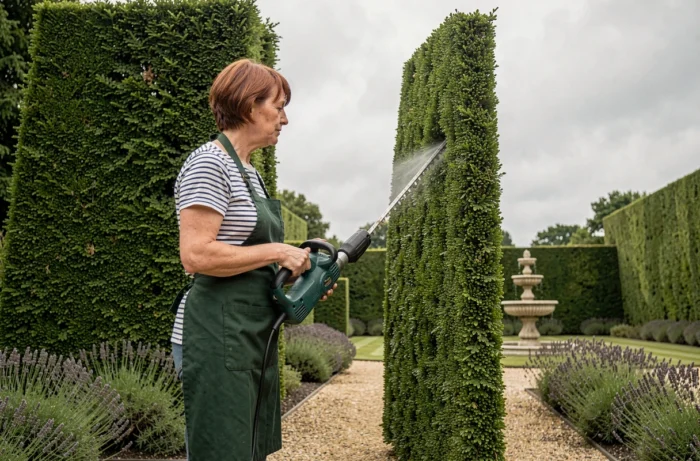
Hedge trimming and legal risks related to nesting
The regulatory reminders of 2026 clarified a point that many gardeners underestimate: destroying a bird’s nest during trimming exposes one to criminal prosecution. The protection of protected species is not an ecological recommendation; it is a legal obligation with severe penalties.
Contrary to popular belief, there is no single national date prohibiting trimming from spring onward. The situation varies according to local prefectural orders and especially according to the actual presence of nests in the hedge. Before any intervention between March and the end of July, we recommend a thorough visual inspection of each side of the hedge.
Verification before cutting: field protocol
- Walk slowly along the hedge, face by face, observing bird movements approaching (frequent back-and-forth to a fixed point indicates an active nest).
- Gently part the outer foliage at suspicious points without introducing mechanical tools. The presence of a nest, even if apparently empty, requires postponing trimming in the affected area.
- Consult the prefectural order of your department to check if a specific prohibition period applies to hedges at property boundaries.
Postponing trimming by a few weeks does not affect the health of the plant. A fine, however, can be quite significant.
Cutting profile and hedge sculpting: geometry that preserves light
A common technical error is trimming the hedge with perfectly vertical sides. This profile deprives the base of light, causing gradual thinning from the bottom and necessitating severe renewal cuts a few years later.
The trapezoidal profile, wider at the base than at the top, ensures uniform sunlight exposure throughout the height. We observe that a slight inclination of the side face is enough to maintain dense low vegetation for years. On fast-growing species like thuja, this profile also reduces the frequency of interventions by limiting apical dominance.
Topiary sculpting: working in successive passes
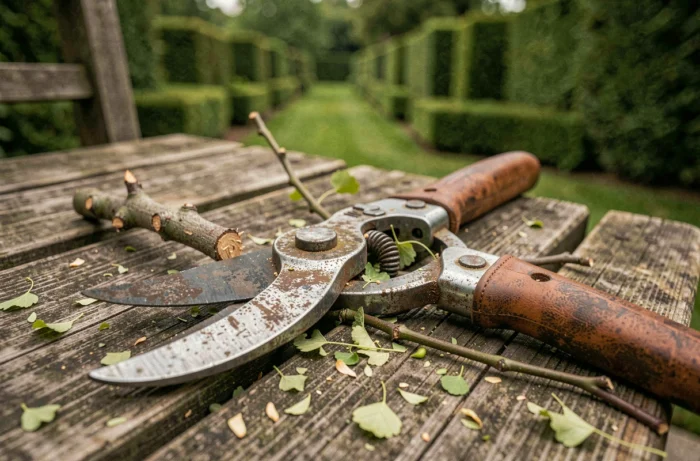
Sculpting geometric or figurative shapes in a hedge relies on a principle of patience. Each pass removes a modest thickness, allowing for symmetry corrections before proceeding further. Wire templates, laid over the plant like a sewing pattern, remain the most reliable method for achieving regular curves.
For complex shapes, a short-blade hedge trimmer offers unmatched maneuverability compared to a standard hedge trimmer, whose cutting length often exceeds what the finish requires. The weight of the tool is as important as the blade length: working with arms extended at the top of a topiary shape with a tool that is too heavy degrades precision in just a few minutes.
Planting distances and neighborhood conflicts around hedges
The Civil Code imposes minimum distances between the hedge and the property line. When the height of the hedge exceeds two meters, the required planting distance increases. These rules, often overlooked at the time of planting, become a source of friction years later when the hedge has grown larger.
Recent disputes show that the neighbor can demand the reduction or even the uprooting of a non-compliant hedge. Jurisprudence regularly confirms this right, even when the hedge is old. Before allowing a hedge to grow freely in height, checking the distance from the neighboring fence avoids costly procedures.
Regular trimming is therefore not just a matter of aesthetics or plant health. It is also a legal precaution: keeping the hedge below the regulatory height threshold eliminates the main cause of conflict between neighbors.
A well-designed trimming program integrates these three dimensions (physiology, biodiversity, regulation) into an annual schedule tailored to each species. It is this holistic approach, more than the choice of a tool or an isolated technique, that distinguishes a simply cut hedge from a truly managed hedge.