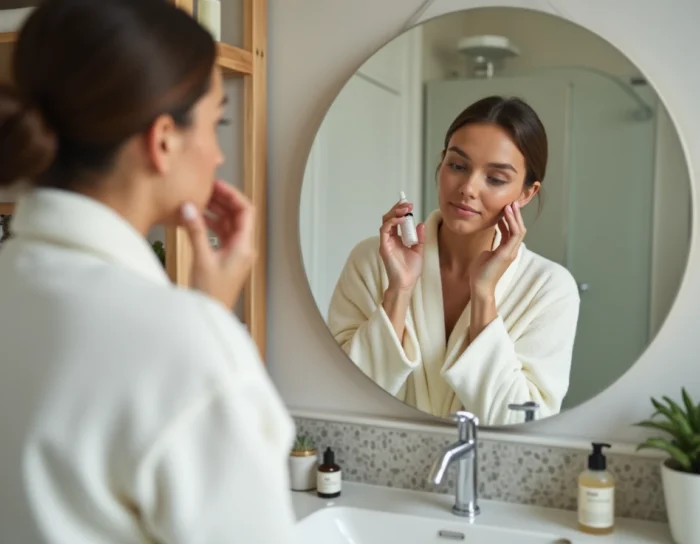
A daily beauty routine relies on a sequence of actions, the order and compatibility of which determine the results on the skin. Applying a serum before a cleanser or layering two exfoliating acids on the same night does not produce a double effect, but rather irritation. Enhancing this routine starts with understanding how each product interacts with the previous one and with your skin type.
Read the INCI list before choosing a facial care product
The INCI list (International Nomenclature of Cosmetic Ingredients) is found on every cosmetic packaging sold in the European Union. Ingredients are listed in descending order of concentration. An active ingredient praised on the packaging but relegated to the end of the list is present in negligible amounts.
This reading has become even more relevant since the implementation of new European regulations. Regulation (EU) 2023/1545 adds 56 fragrance allergens to be declared individually, bringing the list to over 80 substances concerned. Since July 31, 2026, new products marketed must display these mentions. Checking the INCI list protects against unexpected allergic reactions, especially if you have sensitive or reactive skin.
Another point to watch: retinol. Regulation (EU) 2024/996 now caps its concentration at 0.3% retinol equivalent in facial products and 0.05% in body lotions. Non-compliant products can no longer be marketed since November 1, 2025. If you are using a retinol serum purchased before this date, check its concentration on the label.
To delve deeper into these topics and discover product analyses suitable for each skin type, the beauty section of Mam’Zell Plume offers regularly updated content.

Order of application of products: from the most fluid to the most occlusive
The basic rule for a facial care product to penetrate properly is simple: apply textures from the most aqueous to the most oily. An aqueous serum applied over a thick cream will not penetrate the already formed lipid barrier.
Typical morning sequence
- Gentle cleanser suitable for your skin type (foaming gel for combination to oily skin, milk or micellar water for dry skin), which removes the sebum accumulated overnight
- Targeted serum (vitamin C for radiance, niacinamide for enlarged pores or spots), applied on slightly damp skin to facilitate absorption
- Moisturizing cream, which seals in the hydration provided by the serum and forms a protective film
- Sunscreen as the last step, even on cloudy days, as UV rays penetrate through clouds
The eye contour, if you use one, should be applied after the serum and before the moisturizing cream. The skin in this area is significantly thinner than the rest of the face, which justifies a dedicated product formulated without overly concentrated actives.
Typical evening sequence
In the evening, double cleansing makes a difference. An oily product (cleansing oil or balm) dissolves makeup and sunscreen. A water-based cleanser then removes any residues. Double cleansing prepares the skin to absorb nighttime actives.
More powerful actives (retinol, exfoliating acids like glycolic acid) should be reserved for the evening, as they increase photosensitivity. Apply them after cleansing, before your night cream.
Microplastics in cosmetics: what is changing concretely
Beyond the choice of actives, the overall composition of your products is evolving due to regulation. Regulation (EU) 2023/2055 gradually restricts intentionally added microplastics in cosmetics. Exfoliants containing plastic microbeads are the first to be affected. Rinse-off cosmetics must comply by October 2027, and leave-on products (serums, moisturizers) will follow.
In practice, this means that polyethylene-based scrubs will gradually disappear from shelves. Alternatives already exist: apricot kernel powder, rice grains, chemical exfoliating acids (AHA, BHA). The latter have the advantage of not creating micro-lesions through friction, unlike mechanical exfoliants with large grains.

Adapting your beauty routine to your skin type rather than trends
A product praised on social media has no reason to suit all skin types. The skin type determines the choice of textures and actives, not the popularity of a serum or cream.
Oily skin struggles with thick plant oils in daytime care but benefits from a niacinamide-based serum that regulates sebum. Dry skin, on the contrary, needs oily substances (shea butter, squalane) to restore its skin barrier and tolerates aggressive foaming cleansers poorly.
Combination skin concentrates excess sebum on the T-zone (forehead, nose, chin) and has normal to dry cheeks. The most effective approach is to modulate products by area rather than seeking a single “combination skin” care that will inevitably be a compromise.
- Shiny T-zone: gentle foaming cleanser, mattifying serum, lightweight non-comedogenic moisturizer
- Dry cheeks: soap-free cleanser, hydrating serum (hyaluronic acid), richer cream applied locally
- Eye contour: specific product regardless of the area, as the fineness of this skin does not tolerate the same concentrations of actives
This zonal approach takes a few extra minutes but avoids the trap of a universal miracle product that solves nothing properly.
Consistency matters more than sophistication. A simple routine applied every day yields better results than a complex routine followed intermittently. Three well-chosen products used morning and night are enough to maintain healthy skin: a cleanser, a targeted treatment, and a moisturizing protection.