When looking to fill a child’s daily life, most lists offer the same recycled craft activities from one site to another. The real challenge, to brighten your children’s daily routine with style and fun, lies elsewhere: in balancing screen time, physical activities, and creative moments, a trade-off that recent French recommendations have made more concrete.
Screens and screen-free activities: what recent French guidelines say
Since July 13, 2024, all digital devices sold in France come with a built-in parental control system, which can be activated from the first use. This requirement changes the game: families now have a technical lever, not just theoretical advice, to structure the time spent in front of a screen.
At the same time, a commission of experts submitted a report to the French presidency in April 2024, recommending no screen time before age 3, very limited use thereafter, no mobile phones before age 11, and no internet-connected smartphones before age 13. Access to social networks is postponed until later in adolescence.
| Age Group | Screen Recommendations (France, 2024) | Impact on Activities |
|---|---|---|
| Under 3 years | No screens | Sensorial games, free motor skills, shared reading |
| 3-6 years | Very limited use, supervised | Craft workshops, adapted board games, nature outings |
| 6-11 years | Supervised, no personal phone | Long creative projects, sports, construction games |
| 11-13 years | Phone allowed, no connected smartphone | Collaborative activities, cooking workshops, physical challenges |
This regulatory framework encourages rethinking children’s days not as a schedule of activities, but as a thoughtful alternation between stimulation and quiet time.
Exploring Mister Papa’s child universe allows you to find games and toys that fit this logic of screen-free activities, tailored by age group.
Creative activities for children that stand out
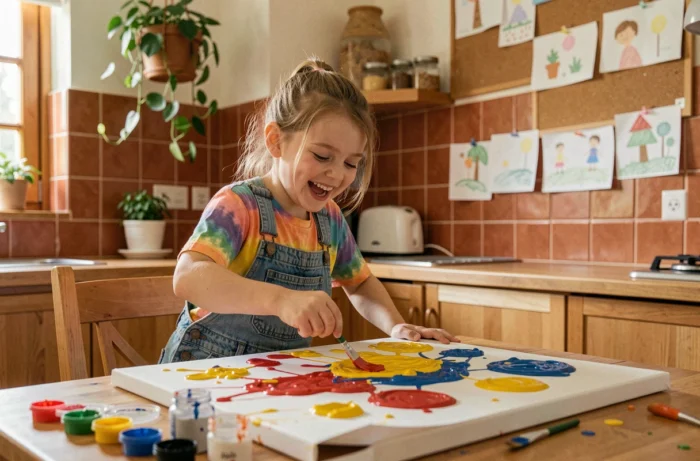
Salt dough and coloring remain classics. Their limitation: they do not evolve with the child. Families looking for original ideas benefit from focusing on formats that combine creation and storytelling.
Inventing a universe rather than reproducing a model
A workshop where the child creates a character, draws a setting, and improvises an oral story engages fine motor skills, language, and imagination. This type of project works from age 4 and can extend over several days, unlike a one-off craft activity.
Open-ended construction games (without imposed instructions) produce the same effect. A child who builds without a model develops their problem-solving ability, whereas a guided kit primarily focuses on reproduction.
Family cooking: an underrated sensory workshop
Preparing a meal together checks several boxes: handling ingredients (textures, smells, colors), reading recipes for older children, understanding quantity and time. It’s also a moment of transmission that costs nothing more than regular grocery shopping.
Here are some formats that work well by age:
- From age 3: assembling cut fruits by an adult, decorating cookies, mixing pancake batter
- From age 6: simple recipes followed with partial independence (homemade pizza, wraps), weighing ingredients
- From age 9: planning the menu, choosing recipes, managing cooking time with a timer
Family games that create real shared moments
Collaborative challenges create more memorable experiences than solitary activities. The difference lies in a simple mechanism: when the whole family participates, the child associates the activity with a relational moment, not just an occupation.
Physical challenges and themed days
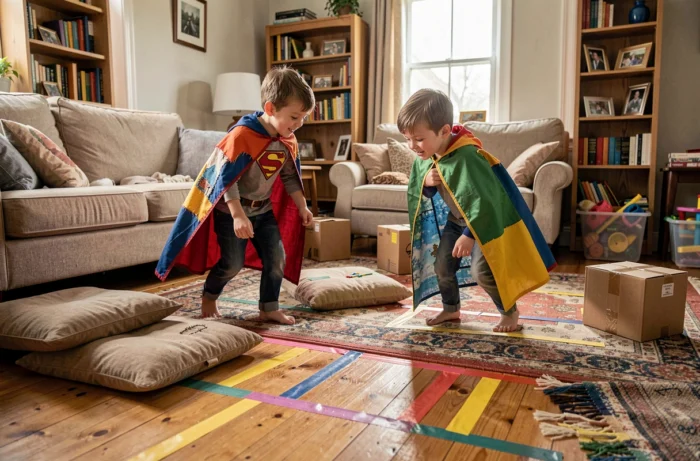
Organizing a “backward day” (breakfast in the evening, pajamas all day) or an obstacle course in the living room requires no equipment. The most memorable activities for a child are those that break the routine, not necessarily the ones that cost the most.
Treasure hunts remain a remarkably effective format. An adult hides clues around the house or garden, each clue leading to the next. The reward can be a symbolic object, a privilege (choosing the evening movie), or a special snack.
Board games: choosing quality over quantity
Accumulating game boxes guarantees nothing. Three well-chosen board games provide more evenings of fun than ten mediocre ones. The important criteria are: a game duration suitable for the age (a 5-year-old loses interest after twenty minutes), rules explainable in under two minutes, and a mechanism that remains interesting after several plays.
Nature outings and outdoor activities for children
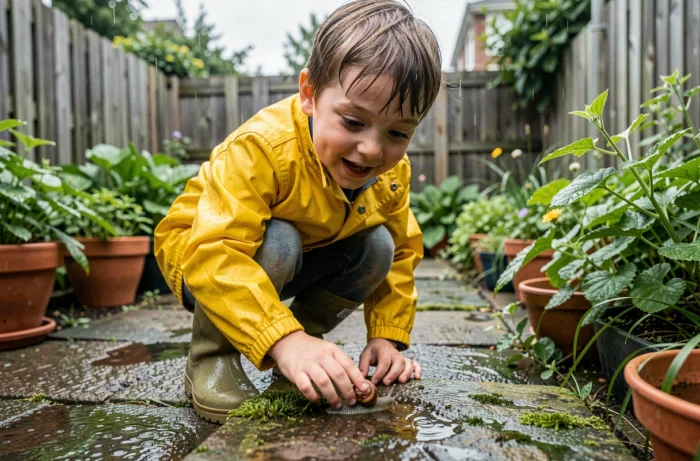
The garden, park, or forest offers a free and renewable playground. Outdoor activities do not need to be spectacular to be effective.
Collecting leaves, pebbles, or insects to create a “nature collection” transforms a simple walk into an exploration mission. A notebook where the child glues, draws, or describes their findings extends the activity over several weeks.
- Observing birds with binoculars (even low-end ones) teaches patience and attention
- Planting seeds in a pot and tracking growth day by day introduces the concept of a cycle
- Building a fort with dead branches fosters cooperation and spatial reasoning
Children who spend time outdoors regularly sleep better and concentrate more easily during the calm activities that follow. The inside-outside alternation structures the day without needing a rigid schedule.
Filling a child’s daily life is not just about stacking activities. The French regulatory framework on screens provides a concrete reference for balancing digital use. The rest relies on three levers: varying formats, involving the whole family, and allowing space for boredom, which remains the best trigger for creativity in a young child.