
Article R313-14 of the Highway Code sets the framework: every motor vehicle must be equipped with direction indicator devices. However, this general wording masks technical subtleties related to the category of the two-wheeler, its date of first registration, and its original homologation. Here, we detail the points that a quick reading of the text does not suffice to clarify.
Original homologation and date of registration: the key to regulatory interpretation
The most frequent confusion arises from a hasty reading of the regulations. The obligation for turn signals primarily depends on the vehicle’s reception, not its engine size. A two-wheeler received before the entry into force of European Directive 93/92/EEC is not subject to the same requirements as a model homologated afterward.
You may also like : All the steps to easily access civil status online in 2024
For motorcycles registered after this directive, four turn signals (two front, two rear) are required from the time of reception. Earlier vehicles must comply with the regulations in force at the time of their homologation. A vintage motorcycle from the 1970s, delivered without original turn signals, can therefore legally operate without them, provided that its registration certificate corresponds to this configuration.
We regularly observe owners of vintage motorcycles wrongly penalized due to a lack of understanding of this distinction. The reference point remains the reception report (or vehicle identification sheet), which specifies the approved lighting and signaling equipment. To delve deeper into the issue of mandatory turn signals on a motorcycle according to Auto XP, the distinction by homologation date is also detailed there.
Further reading : Tarenoi in 2026: What Users Really Think According to Their Reviews
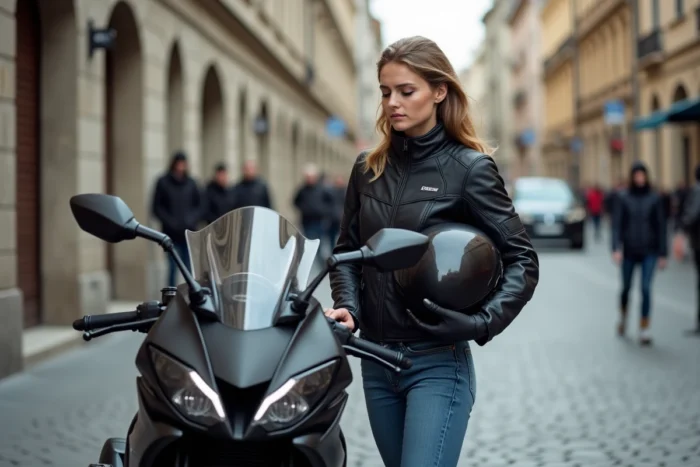
Cyclomotors, scooters, and motorcycles: diverging signaling obligations
Grouping all motorized two-wheelers under a single rule is a technical error. The Highway Code distinguishes several categories, each with its own constraints regarding turn signals.
- L1e category cyclomotors registered after July 1, 2004, must be equipped with front and rear turn signals. Models prior to this date are sometimes exempt depending on their original homologation.
- L3e category motorcycles (over 50 cm³) homologated after Directive 93/92/EEC are systematically equipped with four direction indicators. The absence of a single functional turn signal constitutes a defect liable to penalty.
- Enduros and trials registered for road use follow the same rules as other motorcycles in their category. However, a two-wheeler strictly homologated for off-road use (competition, private land) is not subject to the obligations of the Highway Code, as it does not operate on public roads.
The most common source of confusion concerns “dual-use” enduro motorcycles. When the manufacturer has obtained a European reception including turn signals, removing them renders the vehicle non-compliant, even if the motorcycle primarily operates off-road.
Motorcycle technical inspection and turn signal verification
The technical inspection of motorized two-wheelers changes the game. Where a motorcyclist could previously ride with a faulty turn signal without immediate risk (outside of a road check), the technical inspection requires a systematic check of all signaling devices.
The inspection point focuses on functionality, compliance with the homologated type, and flashing frequency. A turn signal that flashes too quickly (hyper-flash) or too slowly will be noted as an anomaly. This hyper-flash phenomenon particularly affects motorcycles where the original bulbs have been replaced with LEDs without adapting the circuit’s resistance.
Case of hyper-flash after LED conversion
Replacing filament bulbs with LEDs reduces the electrical consumption of the turn signal circuit. The flasher unit interprets this drop in consumption as a burnt bulb and speeds up the flashing rate. Without a compensating resistor or an adapted LED flasher unit, the flashing becomes non-compliant.
We recommend either installing a compatible LED flasher unit or adding resistors in parallel on each turn signal. The first solution is technically cleaner, while the second generates heat and partially negates the energy-saving benefits of switching to LEDs.
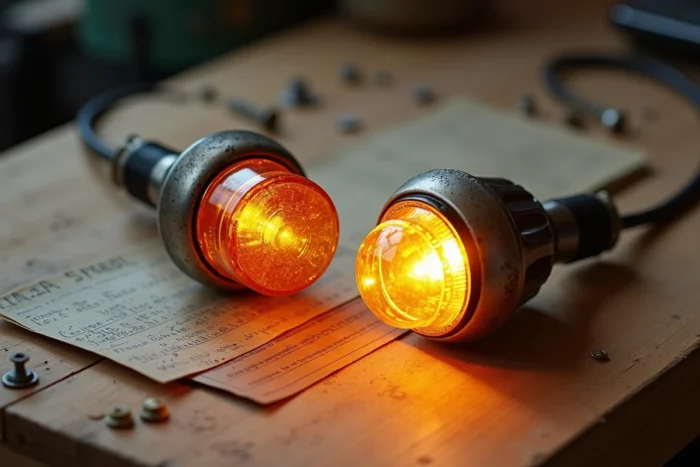
Arm signaling: legal alternative or mere tolerance?
Extending the arm to indicate a change of direction is a gesture taught to cyclists. Some motorcyclists practice it, especially at low speeds or in case of a faulty turn signal. The Highway Code does not accept the arm as a substitute for turn signals on a vehicle that is originally equipped with them.
The nuance lies in the case of vintage vehicles that are not originally equipped. For these models, signaling by arm remains the only legal way to indicate a maneuver, as no luminous device is required by their homologation. In practice, this tolerance applies only to a very limited number of vintage motorcycles.
Impact on motorcycle training and prevention
Motorcycle driving schools reinforce the sequence “mirror, blind spot, turn signal” as a systematic triptych before any overtaking or lane change. Emphasis is placed on the fact that an unindicated maneuver creates a chain reaction: poor anticipation by other road users, disregard for priorities, poorly assessed trajectories. The absence of signaling by turn signal remains a recurring factor in accidents involving two-wheelers.
Whether the motorcycle is vintage, electric, or combustion, the regulatory logic follows a consistent line: if the vehicle has been homologated with turn signals, they must function and be used. The only lever for exemption remains the date and type of vehicle reception, not the rider’s habits or the traffic context.