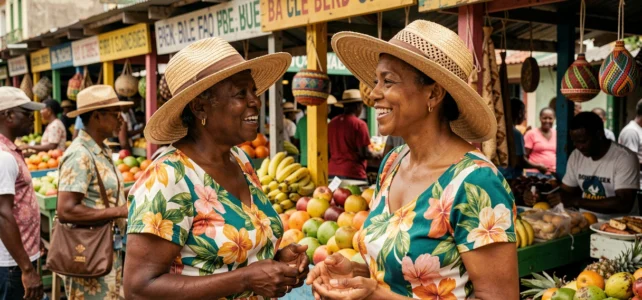
Jamaica’s official language is English, a direct legacy of British colonization. This language structures the country’s administration, education, and media. In daily practice, the vast majority of the population communicates in Jamaican Creole, locally referred to as patwa, a creole language with an English lexical base that has its own grammar and phonetic rules.
English-patwa alternation: a linguistic reality that guides ignore
Travel articles present the Jamaican situation in a binary way: official English on one side, folkloric patois on the other. This description misses the central mechanism that organizes communication on the island.
Recommended read : How to Obtain an Individual Civil Status Certificate and What Is It Really Used For?
Jamaicans do not choose between two fixed languages. They navigate a linguistic continuum that ranges from standard Jamaican English (used in formal speech, a classroom, or a courtroom) to the densest patwa, reserved for exchanges among close friends or in culturally marked contexts like dancehall music.
The same speaker can, during a single conversation, shift from one register to another depending on their interlocutor, the topic at hand, and the degree of formality. A merchant in Montego Bay will greet a tourist in standard English, then switch to patwa as soon as they address a colleague. To better understand the language spoken in Jamaica, it is essential to grasp that this alternation is neither accidental nor approximate: it follows specific social codes that every Jamaican masters from childhood.
Related reading : Discover the best alternatives to replace Tirexo and access your favorite content
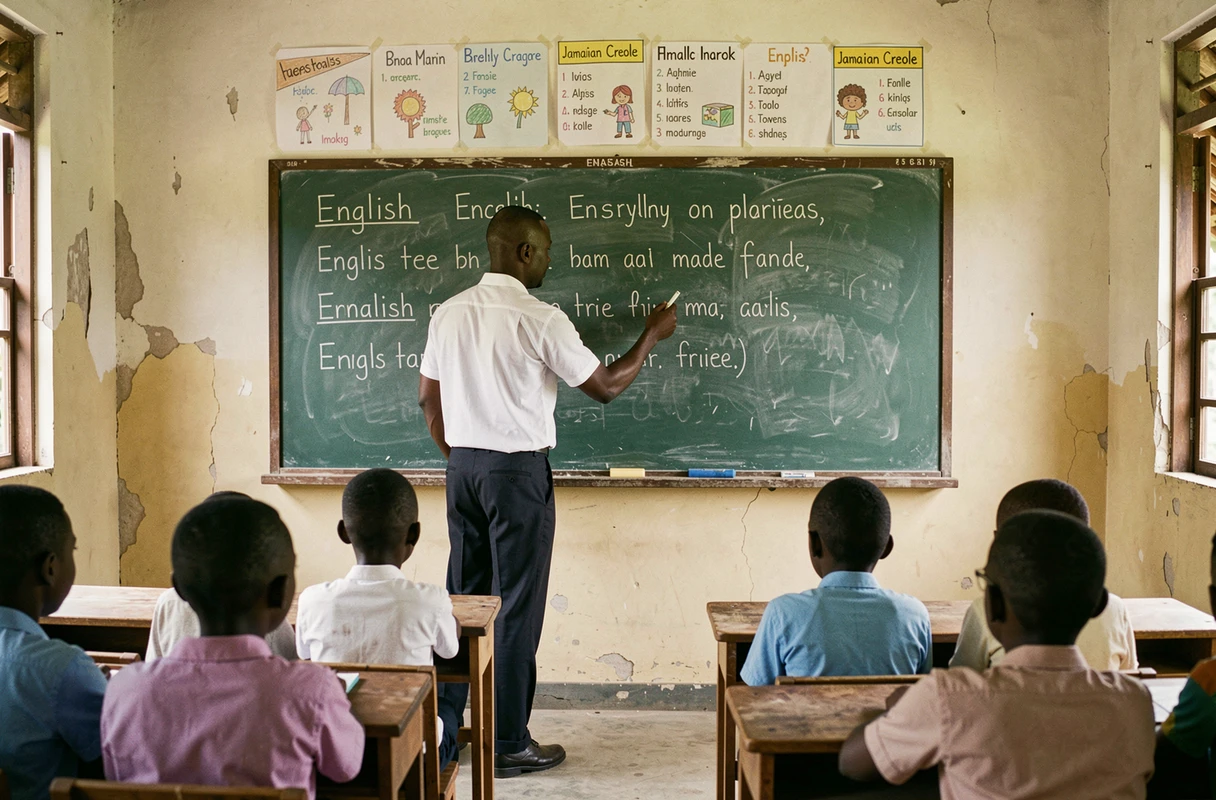
This fluidity explains why an English-speaking visitor can, upon arriving in Kingston, perfectly understand a hotel receptionist and find themselves lost a few minutes later in a market. The register has changed, but not the language in the administrative sense of the term.
Origins of Jamaican Creole: a multilingual linguistic contact
Patwa did not result from a simple distortion of English. Its genesis dates back to the slave period when populations deported from West Africa had to communicate with each other and with British colonists without a common language.
The creole was built by layering linguistic strata: a predominantly English vocabulary, a grammatical structure influenced by several West African languages (akan, igbo, yoruba), and older traces linked to the first European occupants of the island.
- The Spanish controlled Jamaica before the British, leaving place names and a few terms in the local lexicon.
- Akan languages contributed to the formation of certain syntactic constructions, notably the frequent absence of verb conjugation in favor of temporal markers placed before the verb.
- Taino influences (the indigenous people of the Caribbean) remain in place and plant names, even though this layer is the oldest and least visible.
The result is a fully-fledged creole language, with a phonology, morphology, and syntax that distinctly set it apart from English, even if an English speaker can recognize part of its vocabulary.
Patwa grammar: what distinguishes it from English
To understand why patwa is not “badly spoken” English, a few structural differences suffice. The verbal system operates without conjugation in the traditional sense. Instead of modifying the verb’s ending, Jamaican Creole uses pre-verbal particles to indicate tense and aspect.
The marker “did” or “ben” signals the past, “a” or “de” indicates an ongoing action, and the absence of a marker refers to a habitual present. “Mi a go” (I am going) illustrates this logic where temporality is constructed around the verb without modifying it.
The structure of pronouns also differs. “Mi” replaces “I,” “me,” and “my” depending on its position in the sentence. This apparent simplification actually masks a coherent system where the syntactic context removes any ambiguity.
Patwa has its own systematic phonetic rules. The English “th” becomes “t” or “d” (thing becomes ting, the becomes di). These transformations are not random: they follow regular patterns documented by Caribbean linguists.
Institutional debate on the official status of patwa
Long considered an informal dialect, Jamaican Creole is the subject of a movement for institutional recognition. Several political and academic voices in Jamaica advocate for granting it official status alongside English.
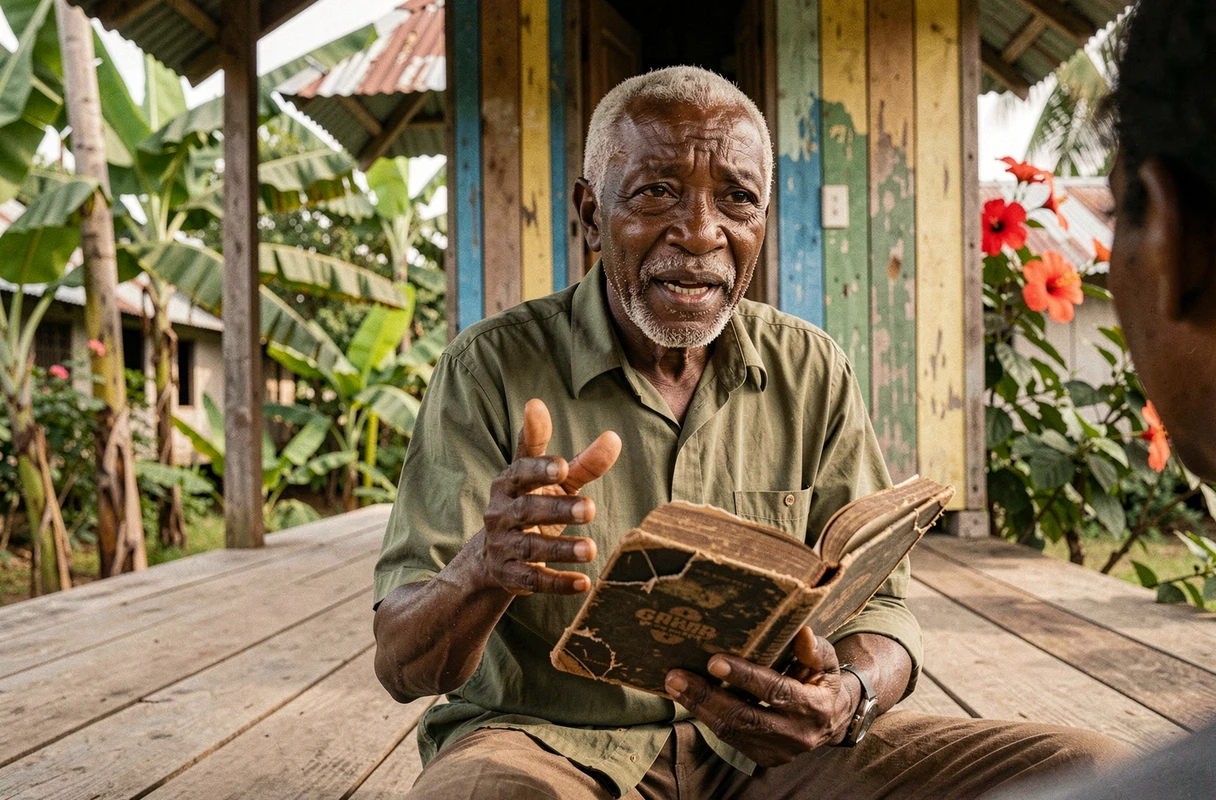
The stakes go beyond symbolism. In the Jamaican education system, children arrive at primary school with patwa as their mother tongue. Teaching is conducted in standard English, creating a gap comparable to that experienced by students educated in a second language. Officially recognizing the creole would allow for adapting teaching methods.
The Bible has been translated into Jamaican Creole, and several initiatives are seeking to standardize its spelling. The University of the West Indies, based in Kingston, plays a role in documenting and academically promoting this language.
- The translation of religious and administrative texts into patwa has been progressing for several years.
- There are Jamaican Creole-English dictionaries, even though no single spelling standard has yet reached consensus.
- Dancehall, reggae, and dub poetry have significantly contributed to spreading patwa well beyond Jamaican borders, granting it international cultural prestige.
This debate remains open. English retains its role in institutions, international trade, and tourism, while patwa remains the primary vehicle of Jamaican cultural identity. The coexistence of these two linguistic codes, far from being a handicap, reflects a population’s ability to master multiple registers depending on the circumstances, a skill that linguistics calls code-switching and that Jamaica practices daily with remarkable ease.