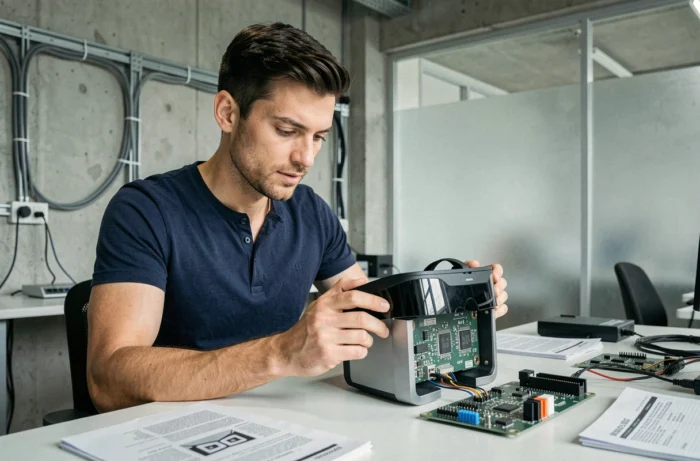
The European AI Act came into effect on August 2, 2026, bringing with it a regulatory layer that now conditions the deployment of any innovation incorporating artificial intelligence in the European market. Tech enthusiasts following new high-tech products must take this into account: a connected object or an AI service launched in Europe can no longer ignore the obligations of transparency and marking of generated content.
AI Act and AI marking: the regulatory constraint reshaping tech products
Since August 2, 2026, European regulation 2024/1689 requires systems that interact directly with people to clearly indicate that they are AI, unless the context already makes it obvious. Content generated or manipulated by AI (text, image, audio, video) must be technically marked to be identifiable.
Systems already on the market before this date have a compliance deadline set for December 2, 2026. Financial penalties for general-purpose AI (GPAI) models have been fully applicable since August 18, 2026, ending the grace period.
In practical terms, this means that smart glasses, voice assistants, and chatbots integrated into connected objects must include disclosure mechanisms from their design stage. For manufacturers, this is an additional engineering requirement. For users, it ensures they know when a machine is responding to them. We observe that several Asian manufacturers have had to delay their European launches to comply with these requirements, altering the release schedules that tech enthusiasts were accustomed to.
Those who wish to search on Hebdo Linux for detailed analyses on these topics will find regularly updated technical files on the impact of this regulation.

Edge AI and embedded NPU: local processing as the new standard
Edge AI is gradually replacing the cloud for inference tasks on consumer devices. The trend is no longer about prototypes: mobile processors and chips dedicated to laptops now integrate neural processing units (NPU) capable of running language models directly on the device.
The technical interest is threefold:
- Latency drops significantly since data no longer travels to a remote server, making interactions with an AI assistant nearly instantaneous.
- Data privacy is enhanced by default: voice queries, analyzed images, and generated texts remain on the terminal.
- Energy consumption per inference decreases, a compelling argument in a context where the carbon footprint of AI data centers is increasingly scrutinized.
We recommend monitoring the upcoming generations of ARM and x86 chips integrating dedicated NPUs. The criterion to check when purchasing is no longer just the raw power of the CPU or GPU, but the NPU’s ability to execute on-device language models (embedded LLMs) with an acceptable thermal envelope.
Smart glasses and spatial interfaces: beyond the gadget
Augmented reality glasses have reached a functional milestone. The latest models project a screen into the user’s field of vision with sufficient resolution to replace a secondary monitor. This is no longer a demonstration product reserved for trade shows like CES.
The integration of natural interfaces (eye tracking, gesture recognition, voice commands) allows navigation through layers of information without external devices. In professional settings, specialized glasses for industrial operations combine real-time annotation and local AI assistance.
The technical point to watch concerns the effective field of view and retinal persistence. Marketing specifications announce wide angles, but the useful field (the area where the display remains sharp and readable) is often more limited. Before any purchase, we recommend checking independent tests on this specific parameter.

Connected objects and predictive cybersecurity: what’s changing for the smart home
Smart home IoT is no longer just about controlling light bulbs from a smartphone. Next-generation connected objects integrate environmental sensors (air quality, temperature, humidity) coupled with local decision algorithms. A connected mirror analyzes health parameters. A home reactor continuously purifies water with real-time monitoring.
The trade-off for this densification of sensors is the attack surface. Preventive and predictive cybersecurity based on behavioral analysis is becoming a selection criterion for any home automation ecosystem. “Zero trust” solutions applied to the home network are no longer reserved for businesses.
Points to check before investing in a connected ecosystem:
- The frequency of firmware updates and the duration of support announced by the manufacturer.
- The presence of end-to-end encryption for health or environmental data collected by sensors.
- Compatibility with open protocols (Matter, Thread) rather than proprietary lock-in that makes the whole system vulnerable if the manufacturer ceases operations.
Robotics and virtual simulation: learning before deployment
Domestic and industrial robots benefit from an approach that modifies their reliability in real-world conditions: training in simulated environments before any physical interaction. Platforms allow a robot to be subjected to thousands of virtual scenarios (obstacles, ground textures, lighting variations) to refine its behaviors without material risk.
This method significantly reduces development time and error rates at deployment. For tech enthusiasts considering the acquisition of a service robot, the differentiating criterion is no longer the driving power but the quality of the manufacturer’s learning pipeline.
The AI Act also applies here: any robot interacting with people in a domestic or commercial setting must comply with transparency obligations regarding its capabilities and decision-making limits. High-tech innovations in robotics are no longer judged solely on their performance, but on their regulatory compliance and the robustness of their training.