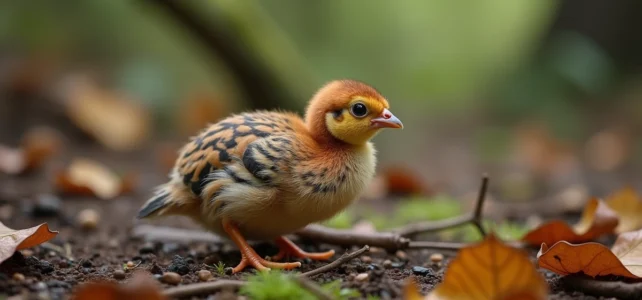
The pheasant chick belongs to the precocial birds: from hatching, it leaves the nest, follows its mother, and searches for food. This behavior, very different from that of passerines which stay in the nest for several weeks, shapes the entire understanding of its development. Recognizing a baby pheasant requires knowing what to observe, and especially at what stage, as its appearance changes quickly and reliable indicators are not always what one might think.
Juvenile plumage of the pheasant: what the down reveals and what it masks
At hatching, the pheasant chick is covered in brown-chamois down sprinkled with dark stripes on its back. This cryptic coloration makes it difficult to spot in tall grasses or field edges. The contrast with the adult male, recognizable by its copper plumage and dark green head, is striking.
Related reading : Adeli number for nurses: how to obtain it and why it is essential
This down gradually disappears in favor of juvenile feathers, which are also brown and dull. For several weeks, males and females remain visually identical. Ornithological guides recommend not attempting too early a sexual identification based solely on color: male/female differentiation is not reliable at the very beginning.
To delve deeper into the early stages of the baby pheasant, one must cross-reference the observation of plumage with that of behavior and size, as down alone is not sufficient to assess the age or health of a chick.
Read also : How to Successfully Print Documents at Leclerc: Practical Guide and Quick Tips
Behavior of the pheasant chick: a more reliable indicator than appearance
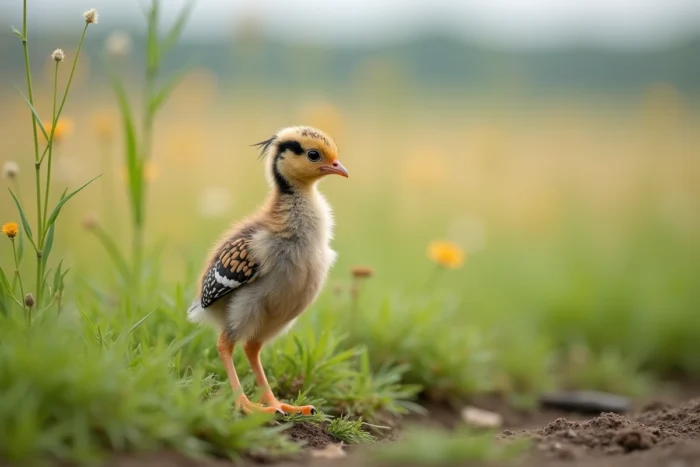
A point often overlooked in general content: for the young pheasant, behavior is a better indicator of good health than plumage color. A healthy chick remains active, alert, reacts to sounds and movements, and approaches food and water spontaneously.
In contrast, a prostrated pheasant chick, with half-closed eyes, that does not react to stimuli or isolates itself from the group should raise alarms. These behavioral signs can be observed from the first hours of life, while the plumage does not yet provide any usable information about health status.
The first days: mobility and feeding
Unlike nestling birds (blackbirds, tits), the pheasant chick is functional very early. Its first hours are dedicated to three activities:
- Moving by following the hen pheasant, sometimes over significant distances relative to the chick
- Pecking at insects and small seeds on the ground, a source of animal protein necessary for rapid growth in the first weeks
- Taking cover at the slightest alert signal, flattening to the ground and relying on the camouflage of its down
This early independence explains why observing a pheasant chick in the wild is difficult: it does not remain still in an accessible nest. It must be sought in motion, often in stubble or low meadows.
Sex identification in young pheasants: at what age and on what criteria
The question of sexing often arises, whether for breeding or simple natural curiosity. In the common pheasant, sexual indicators appear gradually. The first visible signs in young males are the emergence of more colorful feathers on the chest and flanks, followed by the development of red wattles around the eyes.
These markers only become discernible after several weeks of life. Before that, visual sexing remains an estimate, not a diagnosis. In breeding, certain techniques such as cloacal examination can be used earlier, but they require delicate handling and some experience.
Common confusions with other birds
The pheasant chick can be confused with other chicks of game birds, particularly those of the grey partridge or the common quail. A few pointers help distinguish these species:
- Size: the pheasant chick is larger than the quail chick at hatching, with proportionally longer legs
- Down pattern: the dorsal stripes of the pheasant chick form a more contrasted pattern than those of the partridge, with a sharper dark line on the head
- Escape behavior: the pheasant chick tends to flatten to the ground and remain still, whereas the quail chick runs in a zigzag to escape
Raising pheasant chicks: temperature, food, and common mistakes
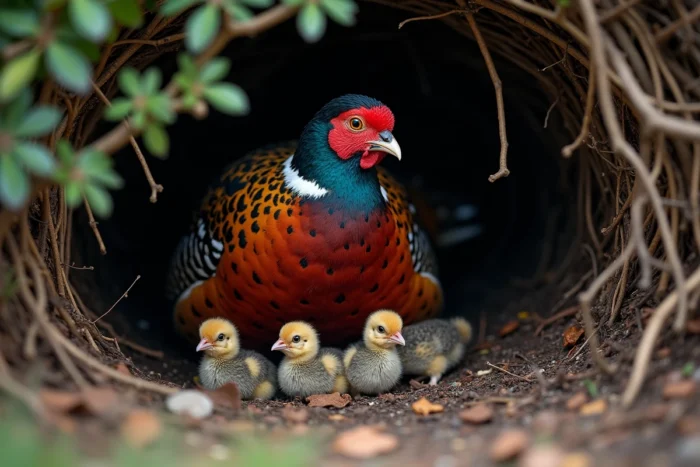
For those raising pheasants, the critical phase occurs in the first two weeks after hatching. The temperature of the incubator or brooder must be sufficiently high at the start, then gradually decreased. A chick that huddles together with others is likely cold. A chick that strays and pants is too hot.
In terms of food, pheasant chicks need a diet rich in protein during their first weeks. A starter feed for game birds is better suited than standard feed for laying hens, as the protein needs of the pheasant chick exceed those of a chicken chick.
The most common mistake in amateur breeding concerns the aviary. Young pheasants are good jumpers and start flying short distances early. An aviary open at the top or with too loose mesh leads to rapid losses. Stress from a space that is too small also causes pecking among chicks, a problem that is difficult to resolve once established.
Recognizing a pheasant chick found in nature: what to do
An isolated pheasant chick in a field or by the side of a path is not necessarily abandoned. The hen pheasant sometimes moves away to feed or to distract a predator. Before any intervention, one must observe from a distance for a sufficient time. If the chick appears active, responsive, and in good condition, the best option is to leave it alone.
If the chick seems injured or weakened (prostrated, eyes closed, no reaction to noise), the appropriate action is to contact a wildlife rehabilitation center. Feeding a pheasant chick bread or milk is a classic mistake that can be fatal: its digestive system requires animal proteins and fine seeds, not human carbohydrates.
The baby pheasant remains a discreet, quick, and well-camouflaged bird. Its recognition relies more on the combination of context (season, habitat, mother’s behavior) and observation of behavior than on visual appearance alone. In both breeding and natural observation, patience and distance remain the best tools.